The Gambino Family: From Murder to Cybercrime History
Sagsdetaljer
Quick Facts
Bloodbath at Sparks: Castellano's murder and Gotti's coup
It was just after five in the afternoon on December 16, 1985, when a black Lincoln Continental pulled up in front of Sparks Steak House on East 46th Street in Midtown Manhattan. In the back seat sat Paul "Big Paulie" Castellano, the 70-year-old boss of the Gambino family, unaware that his own underboss, John Gotti, had planned a bloody coup. As Castellano stepped onto the sidewalk, three men ran out from a nearby alleyway. The sound of gunshots echoed in the cold winter air, and Paul Castellano fell lifeless to the ground along with his bodyguard, Thomas Bilotti.
This audacious murder of Paul Castellano marked not only the end of the Castellano era but also the beginning of one of the most turbulent periods in Mafia history – a period when the Gambino family became a household name far beyond the streets of New York and synonymous with the American Mafia.
Palermo to New York: D'Aquila's tax formed Gambino dynasty
The story of the Gambino family, which culminated in the brutal shooting outside Sparks Steak House, had roots stretching back to the narrow streets of Palermo in the 1870s. Salvatore "Toto" D'Aquila, born in 1873, emigrated to New York, USA, in 1906 and quickly established his power base in the underworld of Little Italy. His organization, originally a faction of the Morello family, broke away and absorbed the remnants of the Brooklyn Camorra, a rival Neapolitan gangster group. D'Aquila's innovative use of "street tax," a form of extortion where shopkeepers paid for "protection," laid the foundation for the powerful organization later known as the Gambino family.
Albert 'Mad Hatter' Anastasia: Murder Inc.'s bloody legacy
After D'Aquila's death in 1928, Albert Anastasia, notorious as "The Mad Hatter" and a feared gangster, took over leadership. He revolutionized the family by establishing Murder, Inc. – a brutal hit squad believed to be behind 400 to 1,000 contract killings between 1929 and 1941, cementing the family's reputation for extreme violence. Many of these murders officially remained unsolved cases, although clues often pointed to Murder, Inc. However, Anastasia's notorious, almost psychopathic behavior and unpredictable violence created internal tensions. On October 25, 1957, Albert Anastasia himself fell victim to a classic Mafia hit when two masked men stormed into his barbershop at the Park Sheraton Hotel and killed him in a hail of bullets.
Carlo Gambino's quiet power: Drugs ban secured alliances
Carlo Gambino, a discreet figure often described as resembling an office clerk, took over leadership in 1957 and ushered in a new era for the Gambino family. Unlike his more flamboyant predecessors, Carlo Gambino favored so-called "grey" crime, such as labor racketeering through union corruption, extortion at JFK Airport, and extensive money laundering through the garment industry – methods that generated enormous sums of money. His strictly enforced ban on drug trafficking ("dealing means death") helped keep the family out of the most intense police spotlight. Through strategic marriage alliances, including his son's wedding to the daughter of rival Tommy Lucchese, Carlo Gambino cemented the Gambino family's position as the most influential of New York's Five Families.
Post-Gambino struggle: Castellano paved way for Gotti
When Carlo Gambino died of natural causes in 1976, he appointed his brother-in-law, Paul Castellano, as his successor. This decision triggered a chain reaction of events that shook the Mafia world. Paul Castellano's focus on white-collar crimes, including complex forms of fraud, and his de-emphasis on traditional street crime alienated many of the family's capos, not least the ambitious John Gotti. The simmering conflict culminated in Castellano's murder, which John Gotti reportedly watched personally from a car across from Sparks Steak House. This brutal takeover, which can be seen as an internal family murder Mafia-style, paved the way for Gotti's era as "The Teflon Don".
John Gotti 'Teflon Don': Media circus and hidden ties
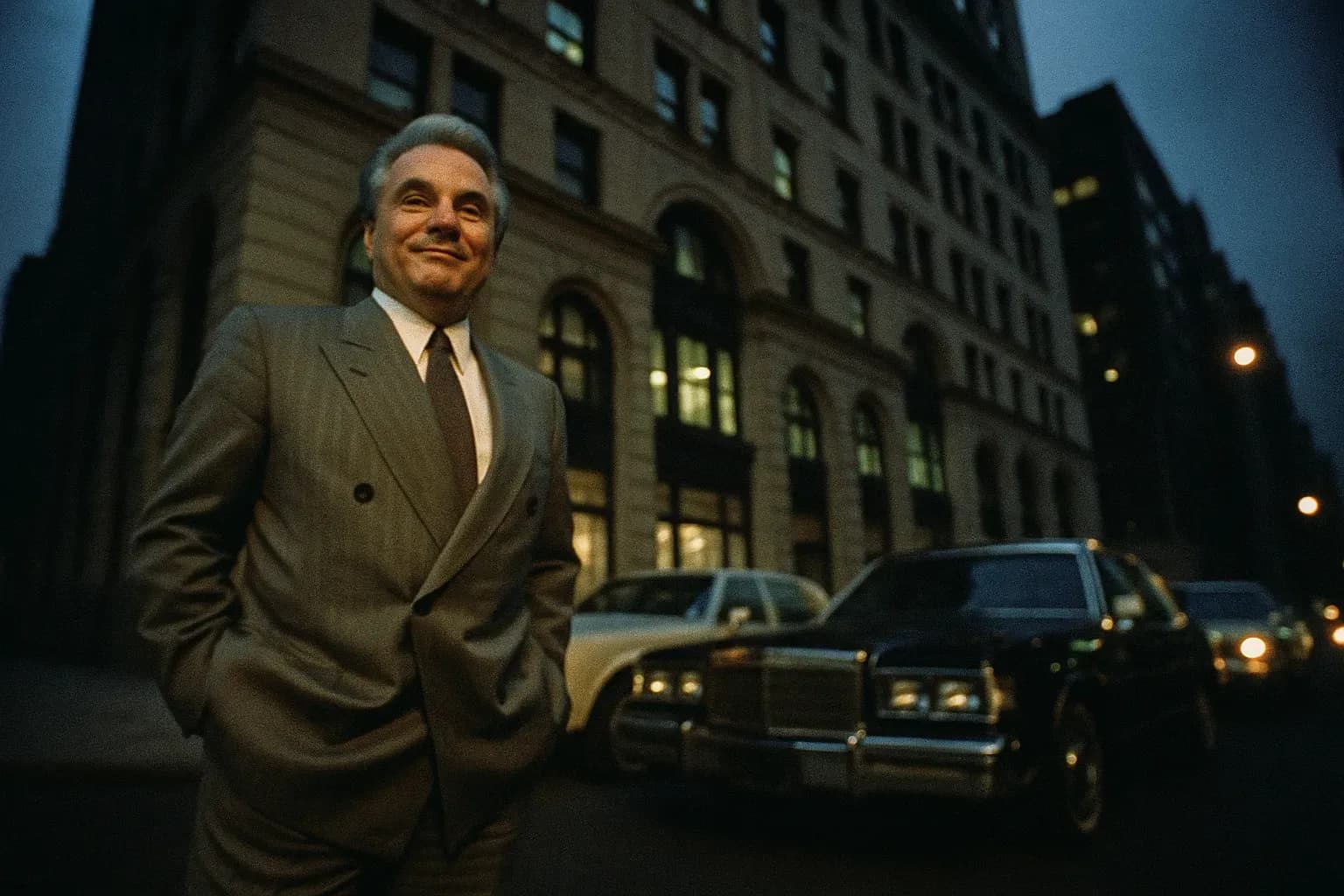
Under John Gotti's leadership (1985–2002), the Gambino family became a media phenomenon, and Gotti himself a notorious gangster celebrity. John Gotti's tailored suits, well-groomed hair, and arrogant smile graced front pages, making him a symbol of modern Mafia power. His three sensational trials, all of which ended in acquittals – allegedly due to suspicions of jury tampering, witness intimidation, and general corruption of the legal process – turned him into a kind of anti-hero in the public eye. But John Gotti's extreme media exposure also created major problems for the Gambino family.
The FBI's Operation Old Bridge in 2008 revealed how the family, under the leadership of Frank Cali, had re-established connections with the Sicilian Mafia, Cosa Nostra. This alliance involved, among other things, heroin smuggling via dockworkers on Staten Island.
Gotti's downfall: Sammy's betrayal and life sentence
John Gotti's downfall came in 1992 when his right-hand man, Sammy "The Bull" Gravano, turned informant and became the state's key witness in a major trial. Sammy Gravano's testimony was devastating; he revealed details of over 19 murders and directly implicated John Gotti as the man who personally ordered Paul Castellano's death. The life sentence, to be served in Marion Federal Prison, marked the end of "The Teflon Don" era, but not of the Gambino family's continued existence in America's criminal underworld. John Gotti's son, John A. Gotti Jr., tried in vain to carry on his father's legacy but met stiff resistance from a new generation of FBI agents who effectively used the powerful RICO Act against organized crime.
Gambino in the 21st century: Cybercrime and corruption
In recent decades, the Gambino family has undergone a significant transformation. Traditional Mafia activities like port extortion and construction site shakedowns have been supplemented by new revenue streams such as cybercrime. A comprehensive police operation in 2024 uncovered how the Gambino family, through a network of offshore gambling sites, had handled over $22.7 million in illegal sports betting. This was combined with a brutal loan-sharking scheme that imposed a weekly interest rate of 5% on victims, a clear form of financial fraud and extortion. The arrest of former NYPD officer Frederick Falcone Sr. as one of the masterminds underscores the Mafia's persistent ability to infiltrate and exploit corruption among public officials.
Violence in 2023: Gambino's ties to Sicily's Cosa Nostra
However, modern methods have not completely replaced traditional violence. During a series of arrests in November 2023, New York police seized hammers, baseball bats, and firebombs that had been used for brutal "debt collection" and extortion targeting demolition companies. One of the accused, Diego "Danny" Tantillo, was even filmed during a violent assault, striking a worker in the head with a hammer – a brutal scene reminiscent of classic Mafia films like "Goodfellas."
A fascinating chapter in the Gambino family's recent history is its strengthened ties to the Sicilian Cosa Nostra. After Operation Old Bridge uncovered the alliance with the Inzerillo family in Palermo, there has been a gradual reintegration of "gli Scappati" – the mafiosi who fled Sicily during the bloody Second Mafia War in the 1980s.
New boss Cefalù: Modern methods ensure survival
Domenico Cefalù, the current boss with roots in Palermo, has managed to restore the Gambino family's position through a combination of traditional Mafia respect and modern business methods. His deliberate strategy of maintaining a low profile stands in stark contrast to John Gotti's media stunts but has proven effective in avoiding the feared RICO indictments and new large-scale trials. The Gambino family's history is a tale of organized crime in the USA, stretching from the harsh conditions of immigrants in the Lower East Side to big money and luxurious lifestyles on Wall Street. Although the number of "made men" in the Gambino family has fallen from around 300 at its peak to approximately 150 today, this Mafia organization continues to adapt to new times.
From 'street tax' to Bitcoin: Tradition vs technology
From Salvatore D'Aquila's early "street tax" and extortion in the 1910s to today's cybercrime and cryptocurrency transactions in the 2020s, the Gambino family has demonstrated a remarkable ability to survive and adapt within organized crime. However, as recent trials in 2023 and 2024 against Gambino family members show, authorities in New York and the rest of the USA remain determined to combat Mafia activities and hold even experienced gangsters accountable for their violence and fraud. In the shadows of New York's iconic skyline, this multi-generational saga of the Gambino family continues, where loyalty and betrayal are eternal themes in the Mafia world. While young "associates" today might discuss Bitcoin transactions on Discord channels, the old capos' codes live on, as Albert Anastasia said: "Money comes and goes, but respect – that's the only thing that lasts." This underscores the deep-seated culture within organized crime.
Want to delve deeper into organized crime and the brutal history of the Mafia? Follow KrimiNyt and get all the details from the real underworld.
Susanne Sperling
Admin