Dennis Rader (BTK): Serial Killer's Kansas Downfall
Sagsdetaljer
Quick Facts
BTK arrested: Digital error leads to Rader's capture
On a cold February day in 2005, a black Jeep Cherokee pulled over in Park City, Kansas. The car was surrounded by police vehicles, and the man behind the wheel – a 59-year-old municipal employee with an effortless smile – was arrested without resistance. He calmly replied when an officer asked if he knew why they were arresting him: "I have my suspicions." The arrest of Dennis Rader marked the end of the hunt for one of America's most notorious serial killers, better known as BTK – an acronym for Bind, Torture, Kill. The question that had plagued investigators and the community in Wichita and the surrounding area for over three decades was finally answered. But how was a man who had evaded detection for 31 years suddenly caught? The answer lay in a trivial mistake, revealing how even an experienced, cold-blooded murderer's arrogance can lead to a downfall in the digital age, where digital evidence plays a crucial role.
Dennis Rader: From family man to dark secrets
Dennis Rader lived a life marked by a terrifying duality. On the surface, he was the epitome of the respectable American middle-class man. He grew up as the eldest of four brothers in Wichita, Kansas, served in the Air Force, married Paula Dietz in 1971, had two children, and was involved in the community as a scout leader and president of the church council at Christ Lutheran Church. His job at a security company even gave him insight into home security – knowledge he later cynically used to break into his victims' homes. Behind this facade, however, lurked a sinister and dark urge. As a teenager, he killed animals, and his fantasies of bondage and strangulation gradually escalated to human victims, a behavior indicative of deep psychological disturbances.
BTK's debut: Otero family murder and letter
BTK's bloody trail of murder and violence began on January 15, 1974. Rader's first victims were the Otero family in Wichita, where the father, Joseph Otero Jr., was a former colleague. This brutal familicide shocked the local community. Rader cut the phone lines, broke into the house, and murdered Joseph Sr., Julie, and their two children, Joseph Jr., 9, and Josephine, 11. They were strangled, and 11-year-old Josephine was found naked and hanged in the basement – a scene Rader later described as a symbolic "gagging of society's innocence." Just a week later, Rader sent his first anonymous letter to the local newspaper, *The Wichita Eagle*, in which he taunted the police for their lack of progress and first introduced the signature BTK.
BTK's terror reign: Ten victims, sudden silence
Over the next 17 years, Dennis Rader killed at least ten people, primarily single women in their own homes in Kansas. His method was consistent and brutal: daylight attacks, using victims' own belongings like stockings or clothes to bind them, sexual subjugation without actual rape, and finally strangulation. He stole personal items – underwear, driver's licenses, jewelry – as trophies and documented his atrocities with Polaroid pictures. In 1977, he left a disturbing poem by the body of Shirley Vian. The following year, he himself called emergency services after murdering Nancy Fox, resulting in a radio broadcast where the public heard BTK's voice for the first time. But after 1991, BTK vanished without a trace, and the case became a long-unsolved mystery for the Wichita police.
BTK breaks silence: Clues reveal 'D. Rader'
The long silence was broken in the most unexpected way in 2004, when BTK resumed communication with an inexplicable, almost taunting self-assurance. On March 22, 2004, *The Wichita Eagle* received a new envelope. It contained photographs of a previous victim, Vicki Wegerle's, body and a photocopied driver's license from 1986, all signed with "BTK revisit." This marked the beginning of a new wave of cryptic messages from the serial killer. In May 2004, he sent a puzzle with hidden words like "D. Rader" and "6220" – his address. In June 2004, a package was found at a stop sign, containing detailed sketches of the Otero family murders.
Fatal floppy disk: Metadata and DNA capture BTK
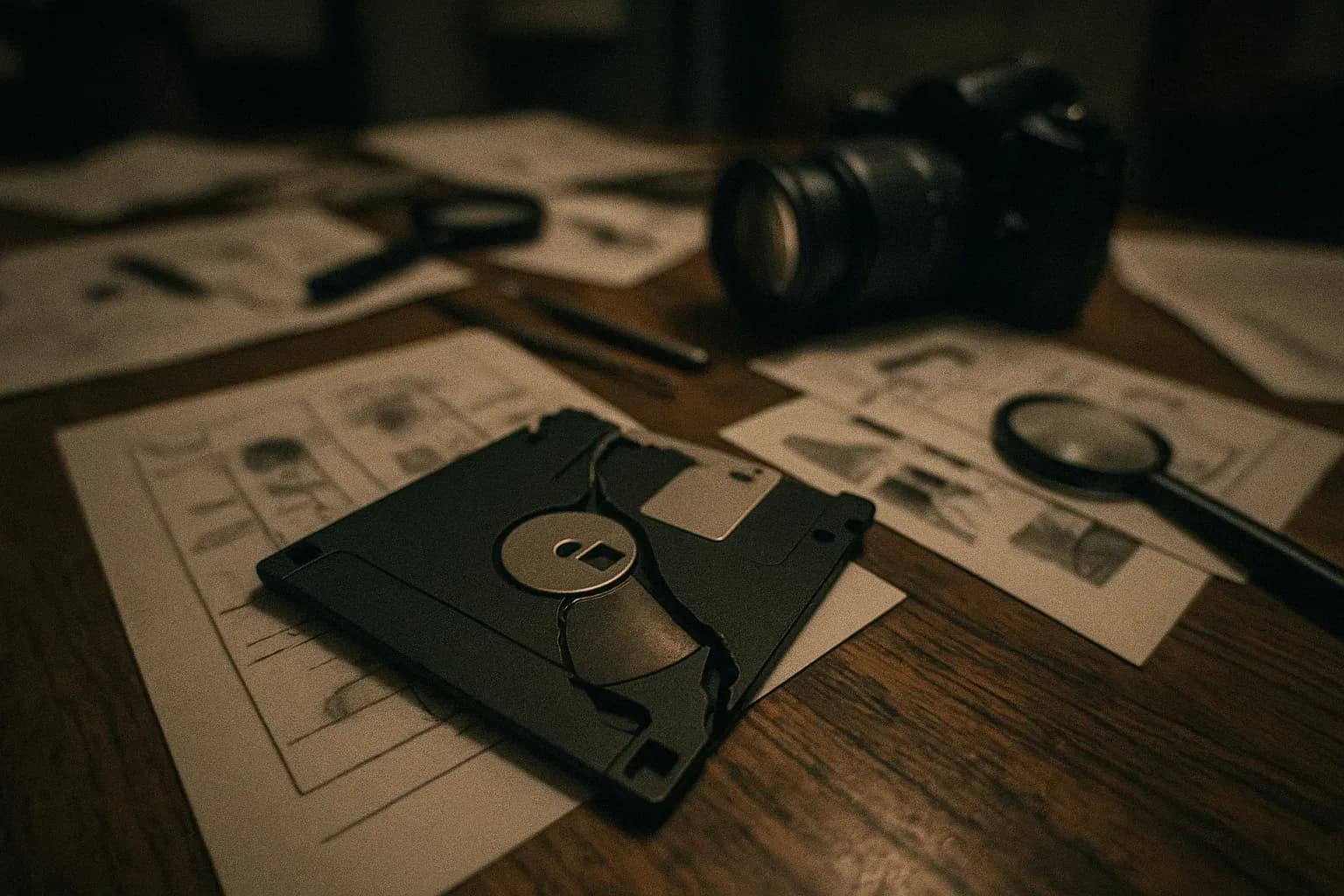
BTK's ultimate misstep came in February 2005. He sent a purple floppy disk to TV station KSAS, believing he had erased all traces. He had even asked the police in a previous letter if they could trace files from a floppy disk. The police had replied that they could not trace a disk if the file was deleted – a deliberately misleading answer. When digital forensic technicians examined the disk, they recovered metadata from a deleted Microsoft Word file. This piece of digital evidence revealed that the file had last been edited by "Dennis" and was linked to Christ Lutheran Church. Police drove past the church and noticed a black Jeep Cherokee, matching a car captured on surveillance video evidence from a previous package drop by BTK. Crucial DNA evidence, discreetly obtained from Rader's daughter (via a Pap smear), was compared to DNA traces found under Vicki Wegerle's fingernails. They matched. At 12:10 PM on February 25, 2005, Dennis Rader was stopped in his Jeep Cherokee and arrested.
Verdict on BTK: Confession and life sentence
In court in August 2005, Dennis Rader confessed to all ten murders with disturbing detail. He described the victims' deaths as "projects" and claimed to be driven by an inexplicable force, "Factor X" – a statement that, along with his general demeanor, sparked discussions about his psychological profile and possible psychopathic traits. Judge Gregory Waller sentenced him to ten consecutive life sentences, equivalent to 175 years in prison without the possibility of parole. During the sentencing, victims' relatives expressed their pain and contempt; Beverly Plapp, sister of Nancy Fox, stated, among other things, that he deserved to be thrown into a black hole to rot. Rader was placed in solitary confinement for 23 hours a day in the maximum-security prison.
BTK aftermath: New leads and forensic advances
The BTK serial killer case has had lasting consequences. In 2023, police in Oklahoma reopened the unsolved case of Cynthia Dawn Kinney's 1976 disappearance after finding clues potentially linking Rader to it – he had previously described fantasies about an abduction from a laundromat. A review of his belongings also revealed possible "trophies" buried at his former properties in Kansas. This extensive criminal case also revolutionized forensic technology, as the use of metadata tracking, familial DNA evidence analysis, and digital evidence recovery became established as standard tools in investigating complex murder and assault cases. As Rader himself reluctantly admitted after his arrest: "The floppy disk got me."
BTK's legacy: Evil facade and tech victory
Dennis Rader's story is a chilling reminder that the most terrifying evil often hides behind a completely ordinary facade. His ability to maintain a double existence as a family man, churchgoer, and simultaneously a sadistic serial killer profoundly challenges our understanding of human behavior and the darkest aspects of the human psyche, sometimes seen in connection with psychopathy. However, his downfall also underscores that even the most cautious criminals are not immune to mistakes, and that the digital age leaves traces – crucial digital evidence – that, with patience and the right forensic technology, can lead to justice. As Kevin Bright, whose sister became one of BTK's strangulation and assault victims, stated: "He thought he was invincible. But technology caught up with him – and finally gave us peace."
Follow KrimiNyt for more in-depth cases on serial killers, psychopathy, and how technology solves the darkest crimes.
Susanne Sperling
Admin