Amazon in Crisis: Environmental Crime and Climate Fight
Sagsdetaljer
Quick Facts
Amazon in Crisis: Is Lula's effort a fragile lifeline?
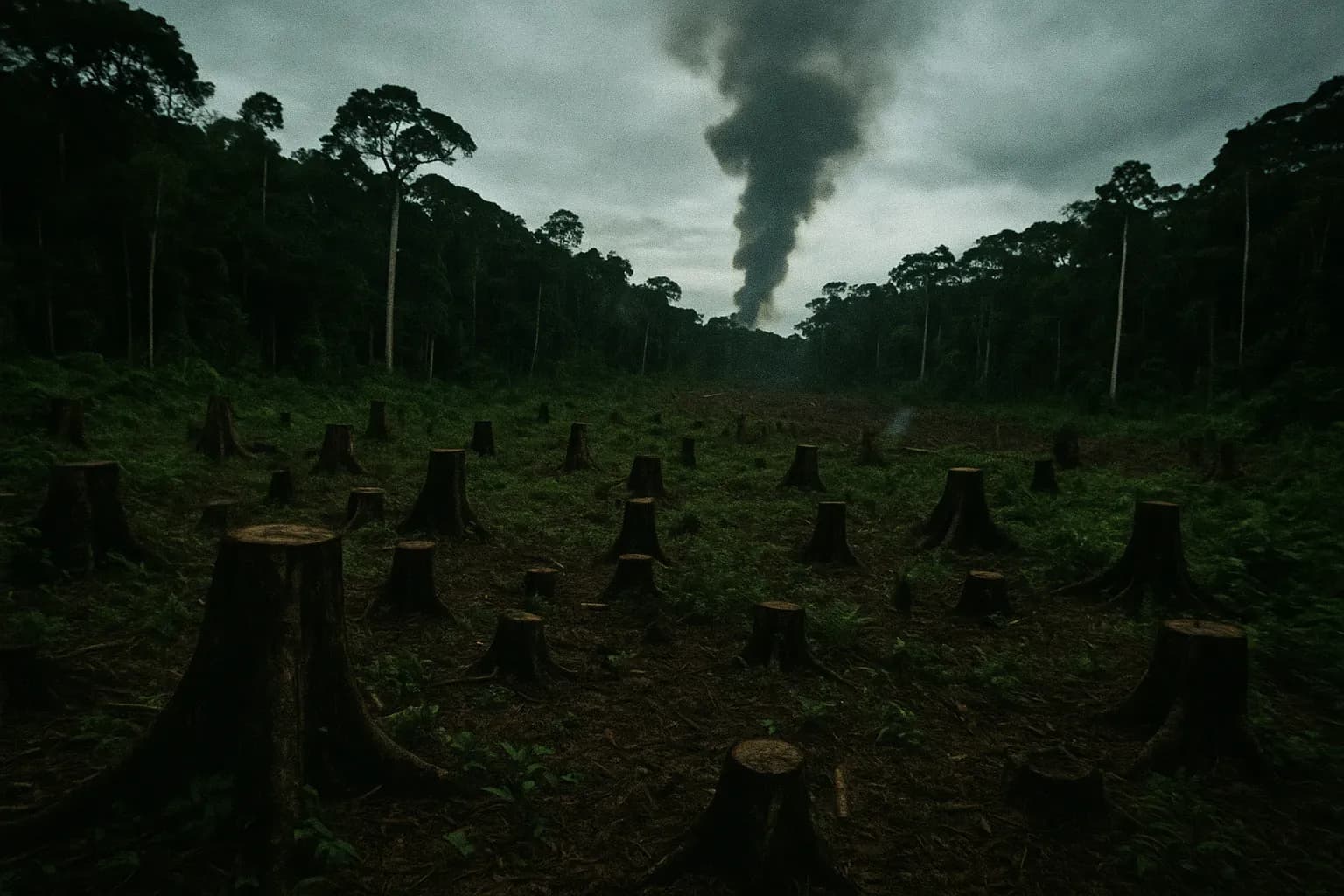
The Amazon rainforest, often called the Earth's lungs, faces an existential crisis. Between 2001 and 2020, a staggering 54.2 million hectares of forest disappeared – an area equivalent to France. Grim forecasts now indicate that an additional 23.7 million hectares could be lost by 2025. This escalating destruction is driven by a complex and often brutal mix of legal business and illegal operations, frequently constituting extensive environmental crime. The main causes are expanding cattle ranching and soy production, as well as massive illegal logging and unscrupulous mining. The consequences are catastrophic: invaluable biodiversity and the global climate balance are threatened, just as the livelihoods of the Amazon's indigenous peoples are crumbling. Although policies in Brazil under President Lula da Silva have slowed deforestation by 22% since 2023, the annual destruction is still far above the levels of the 2010s, underscoring the depth of the crisis.
Military junta to fraud: Cattle and soy drive deforestation
The tragedy in the Amazon has roots dating back to the 1970s. At that time, the Brazilian military junta actively encouraged colonization and deforestation to make way for cattle ranches. This policy laid the foundation for an explosive increase in deforestation, which grew by 352% between 2001 and 2020. Cattle ranching alone is responsible for a shocking 80% of this forest loss. Every day, an area of rainforest the size of 3,500 football fields disappears, much of it through illegal logging and clearing.
In states like Pará, which accounts for 36.4% of recent deforestation, large areas of primary forest have been sacrificed for monocultures of soybeans for soy production. Despite an international soy moratorium from 2006, intended to stop the purchase of soy from newly cleared areas in the Amazon, investigations reveal an ongoing scandal: over 1,000 square kilometers of forest were cleared for soy cultivation in Mato Grosso alone between 2009 and 2019. Farmers systematically circumvent the rules, often with an element of corruption involved, by first using cleared areas for cattle for a few years – a practice known as agricultural rotation – before switching to soy.
BR-319 Highway: Infrastructure fuels illegal activities
Infrastructure projects are the lifelines of destruction in the Amazon. Large highways, like the controversial BR-319 currently being paved, open up previously untouched rainforest areas and make it easier to transport goods from illegal clearings. Satellite data shows that 41% of the Brazilian Amazon is already fragmented by roads. Each new main road triggers a wave of secondary problems: a dense network of illegal side roads, speculative land acquisition – sometimes involving extortion – and violent conflicts over land rights that can escalate to shootings.
Chiquitanía: Deforestation causes drought and dolphin death
In the northern Chiquitanía region, massive deforestation for cattle ranching has altered the local microclimate. Rainfall has decreased by 17%, exacerbating drought and creating ideal conditions for forest fires. In 2023, fires ravaged an area the size of Tennessee – an increase of 35.4% from the previous year, despite a general decline in Amazon deforestation.
The extreme drought in 2023, intensified by the El Niño weather phenomenon and global climate change, resulted in historically low river levels. This tragically culminated in the mass death of 154 river dolphins in Lake Tefé.
Gang Crime: Illegal logging and corruption in the forest
Illegal logging poses an enormous threat to the Amazon. Between 2022 and 2023, 126,000 hectares of rainforest were illegally felled, an increase of 19%. Well-organized networks, operating like criminal gangs, use advanced technology and satellite data to locate valuable trees. They build illegal roads and "launder" the timber through fraudulent "green" certification schemes, often facilitated by corruption and bribery.
In protected reserves like Rio Preto-Jacundá, illegal loggers exploited weakened state control under the previous Brazilian government to fell areas larger than Copenhagen.
Yanomami Tragedy: Illegal mining despite intervention
Meanwhile, illegal gold mining in the Yanomami people's territory in the Amazon has triggered a humanitarian catastrophe. Mercury poisoning, malaria epidemics, and violent confrontations between miners and indigenous people have become commonplace. This form of environmental crime has far-reaching consequences. Although the Lula da Silva government in Brazil deployed the military in 2023 to remove up to 20,000 illegal miners, the harmful mining activities have only temporarily subsided.
Amazon's Tipping Point: CO2 emission and savanna risk
Scientists warn: Continued deforestation affecting 20% of the Amazon's total area could trigger a critical tipping point for the entire ecosystem. If the rainforest becomes too fragmented, it loses its ability to sustain itself by generating its own rain through evapotranspiration – the process where trees release water vapor that forms clouds. A collapse would release an estimated 90 billion tons of CO2, equivalent to 2.5 times the world's annual fossil fuel emissions, and risks transforming large parts of the Amazon into dry savanna. This will accelerate global climate change.
Measurements indicate that the southern part of the Amazon has already shifted from absorbing CO2 to being a net source of greenhouse gases. Since 1980, drought periods have become 2-3 weeks longer, weakening the trees' resilience to forest fires and pests. A study in Science Advances documents how deforestation has already delayed the onset of the monsoon, further reducing vital rainfall in the Amazon basin.
Hope in Darkness: Indigenous fight and looming threats
Amidst the destruction, however, there are bright spots and resistance. Indigenous peoples' territories in the Amazon act as a vital buffer. They cover over half of the Brazilian rainforest's area but account for only 5% of total deforestation. Territories like Suruí and Yanomami have proven to be effective bulwarks against deforestation, despite enormous pressure. In 2023, tree cover loss in these areas fell by 73%, partly thanks to strengthened monitoring and efforts.
President Lula da Silva's reinstated policies, including the reopening of the Amazon Fund, increased inspections, and international cooperation, have shown the first positive signs in the fight against environmental crime in Brazil. Between August 2022 and July 2023, deforestation fell to 9,001 square kilometers – the lowest level since 2018. However, the challenges remain enormous. Plans to pave BR-319, build the Ferrogrão railway, and extract gas in the western Amazon threaten to open new, vulnerable rainforest areas to further destruction.
Crisis Solutions: Agriculture and EU soy halt needed
The way forward for the Amazon also involves the potential of more intensive agriculture. A model from Nature Sustainability suggests that by increasing cattle density on existing pastureland and cultivating soy on already degraded grasslands, an additional 5.7 million hectares of deforestation can be avoided. This, however, requires strong political will to enforce laws, combat land speculation, and steer development away from untouched rainforest.
Global consumption and international business also play a key role. Reports have revealed a widespread scandal: the EU's import of supposedly "deforestation-free" soy for cattle feed is often an illusion. Products from newly cleared areas in the Amazon are "laundered" through complex supply chains, a system that can involve corruption. Future certification schemes must therefore cover the entire production chain, not just isolated crops, to combat this form of environmental crime.
Amazon on the Brink: Global cooperation is last chance
The Amazon is balancing on a knife's edge. The future of this vital rainforest depends on whether the destructive course can be reversed through global cooperation, innovative technology, and strengthened protection of indigenous peoples' rights. The alternative is that the world loses not only an invaluable treasure of biodiversity but also a fundamental climate system that has kept the planet in balance. It is, as one expert puts it, not just about saving trees, but about preserving a complex ecological mechanism that affects global climate change.
With an estimated 400 billion trees still standing in the Amazon, time is short, but hope is not lost. The ultimate fate of the Earth's lungs is being decided in these years.
Follow KrimiNyt for more in-depth cases on crime that shakes our world – from local crimes to global environmental crime.
Susanne Sperling
Admin